

how do hydraulics work

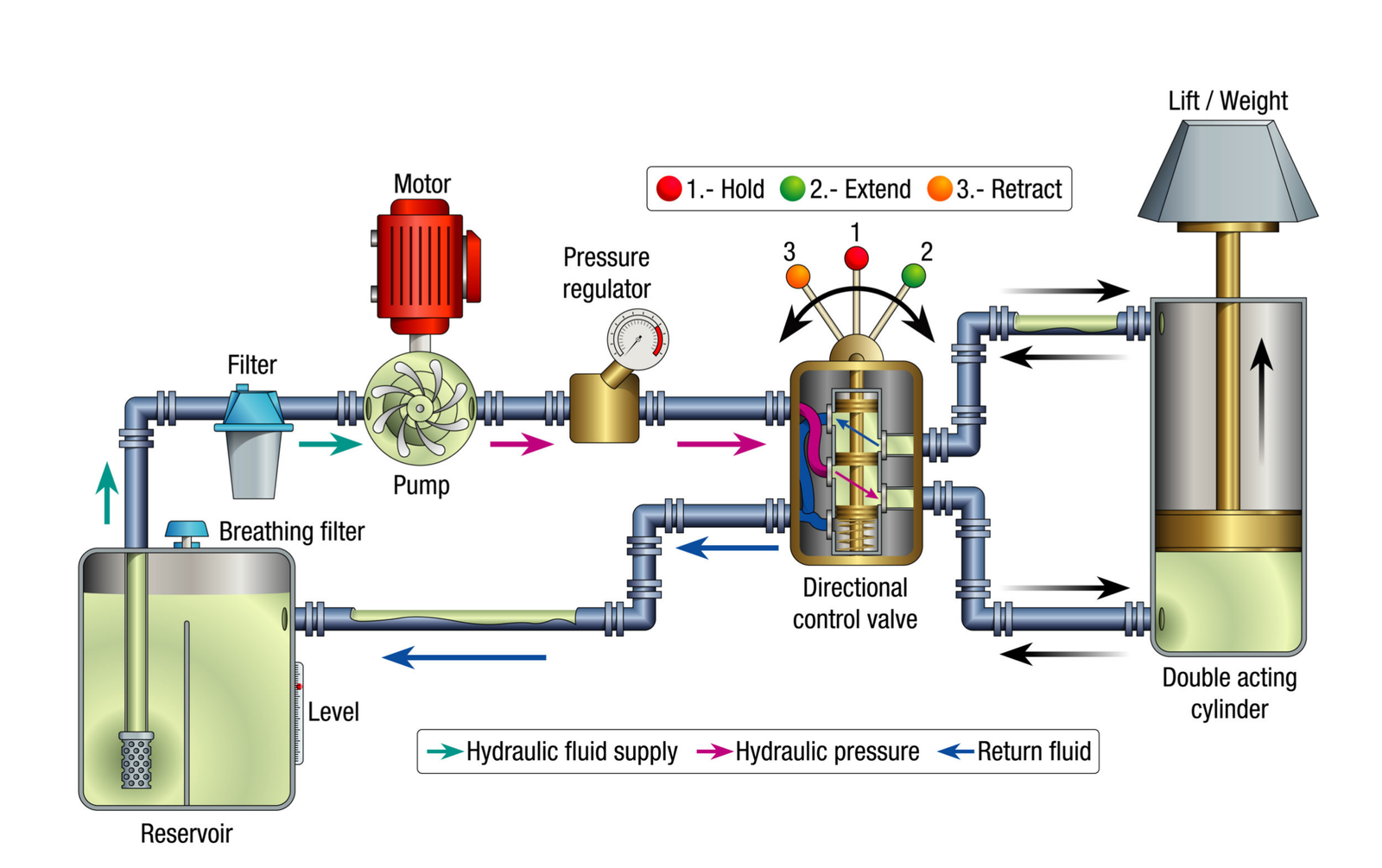
The working principle of a hydraulic system is to use liquid (usually hydraulic oil) as the working medium, and transmit power and motion through changes in sealing volume. Its core lies in using Pascal’s law to increase the force by changing the pressure, thereby achieving efficient energy transfer and control.
A complete hydraulic system mainly consists of five parts working together:
Power component: usually a hydraulic pump, which converts the mechanical energy of the prime mover (such as an electric motor or internal combustion engine) into hydraulic pressure energy, providing power for the entire system.
Execution components: including hydraulic cylinders and hydraulic motors, which convert the pressure energy of liquids back into mechanical energy, driving loads to perform linear reciprocating or rotary motion.
Control components: various hydraulic valves used for precise control and adjustment of liquid pressure, flow rate, and flow direction to meet the action requirements of the executing components.
Auxiliary components: including oil tanks, oil filters, pipelines, seals, etc., they provide support for the system, such as storing hydraulic oil, filtering impurities, connecting various components, etc.
Working medium: hydraulic oil or emulsion, is a medium for transmitting energy, and also has lubrication, cooling, and rust prevention functions.
The workflow of the system is usually as follows: the power component (hydraulic pump) sucks hydraulic oil from the oil tank and pressurizes it, and delivers high-pressure oil to the control component (such as the reversing valve). The control component adjusts the flow direction and flow rate of high-pressure oil according to instructions, and then sends it to the executing component (such as a hydraulic cylinder) to push the piston to move and complete external work. The low-pressure oil after doing work flows back to the oil tank, forming a cycle.
Hydraulic systems can be divided into two categories:
Hydraulic transmission system: With the main function of transmitting power and motion, it is the most common type in daily applications.
Hydraulic control system: pays more attention to the dynamic performance of the system, requiring the output to meet specific accuracy and response requirements, commonly used in precision control applications.
In addition, there are two main forms of hydraulic systems: open systems and closed systems, with the difference being the way the oil circulates.